Best Laser Engravers for Tumblers (2026 Buyer’s Guide)
The best tumbler laser depends first on the surface you plan to mark. Coated drinkware, bare stainless steel, and production batches require different sources, accessories, and budgets.
10-minute guide · Updated September 22, 2026
BeamScout shortlist
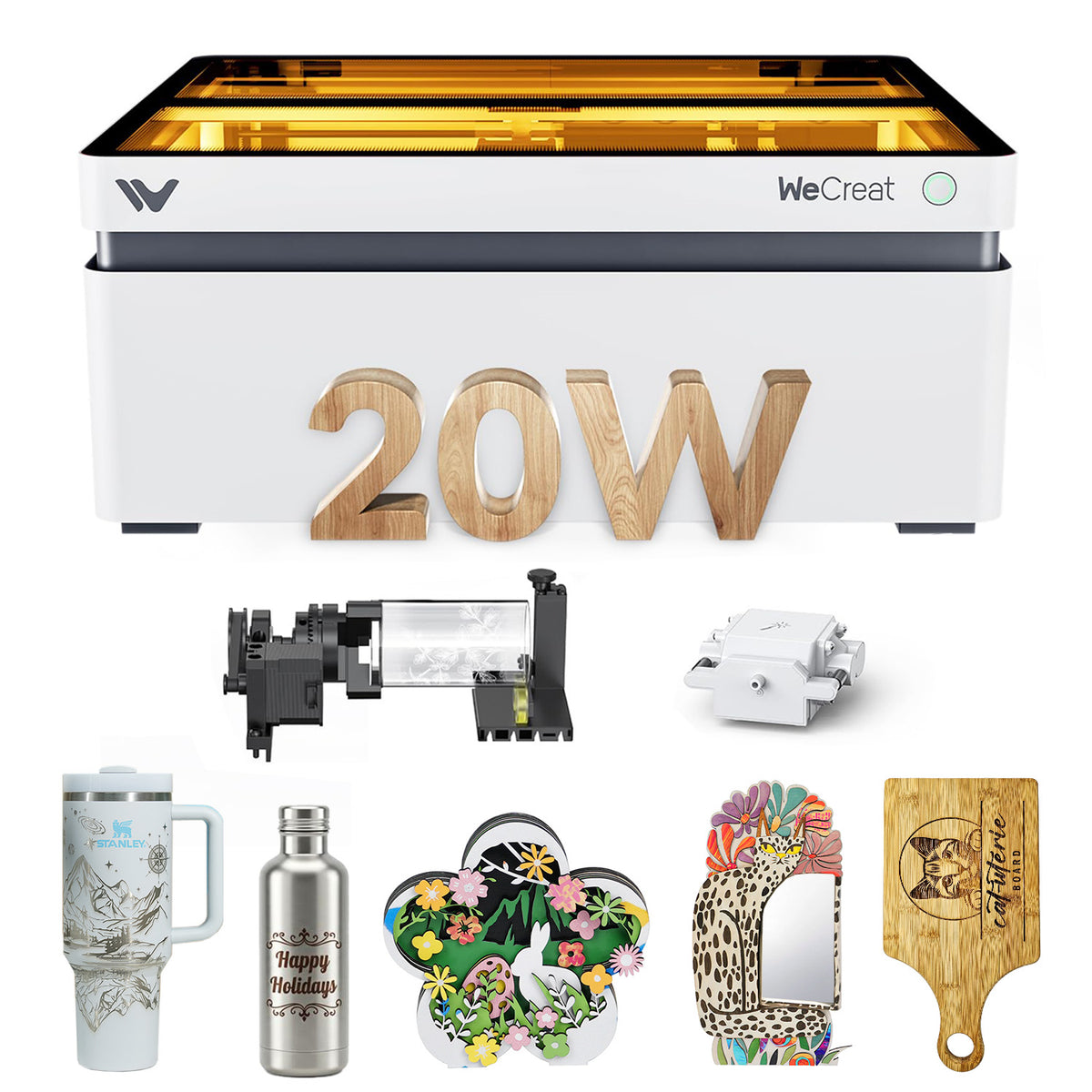
Best enclosed craft setup
WeCreat Vision 20W
Its enclosed auto-lifting format, camera positioning, and rotary expansion path make it a practical starting point for coated tumblers and mixed craft products.

Best beginner-friendly diode option
Creality Falcon A1 Pro
The enclosure, camera autofocus, and built-in air assist reduce setup friction, while an appropriate rotary and clearance solution support coated drinkware.

Best portable mixed-material option
LaserPecker LP5
Its diode and fiber sources are useful when a seller wants both coated-tumbler work and more capable metal marking in a compact personalization setup.
Quick answer: match the laser to the tumbler surface
For powder-coated or painted stainless tumblers, a diode or CO₂ laser can remove the coating and expose the metal beneath. For permanent marks directly on bare stainless steel, compare fiber, MOPA, or suitable infrared systems; a blue diode is not automatically a bare-metal engraving solution. CO₂ machines may use a compatible metal-marking compound, which adds material cost and process steps.
Decide whether your core product is coated drinkware, bare-metal personalization, or both. That choice matters more than advertised speed or wattage.
- Coated tumblers: enclosed diode or CO₂ with a compatible rotary
- Bare stainless: fiber, MOPA, or a verified infrared process
- Mixed product catalog: dual-source systems can reduce machine swapping
- Glass drinkware: verify the exact process and expect testing or surface preparation
What a tumbler-ready setup actually needs
A machine is not tumbler-ready merely because a rotary is sold for it. Confirm the rotary type, maximum diameter, usable length, weight limit, and whether the enclosure has enough height. Many systems need a riser base or open-bottom arrangement before a handled mug or large bottle will rotate without striking the machine.
Roller rotaries are simple for straight cylinders. Chuck rotaries can grip tapered cups, mugs, rings, and irregular items more securely, but usually cost more and require careful alignment.
- Rotary compatible with the exact machine and software
- Enough vertical clearance for the largest cup and handle
- A level fixture so artwork does not drift around the cylinder
- Ventilation or filtration sized for coating fumes
- Test blanks for focus, power, speed, and artwork placement
How the three picks differ
WeCreat Vision 20W is the most straightforward craft-room choice of this shortlist when coated tumblers sit beside wood, leather, and opaque-acrylic projects. Creality Falcon A1 Pro is a beginner-oriented enclosed diode option that still requires the correct rotary and clearance accessories. LaserPecker LP5 costs more, but its dual-source design better fits mobile personalization and buyers who expect to mark both coated products and selected bare metals.
Use each BeamScout profile to compare the current machine allowance, likely extras, workspace format, software, and manufacturer buying links. Accessory bundles and sale prices change, so verify the rotary and riser included with the exact package you are considering.
Workflow matters more than headline speed
A tumbler job includes measuring, artwork wrapping, alignment, rotary setup, focusing, testing, cleaning, and inspection. Camera positioning can help with placement, but a repeatable jig and saved settings often determine real batch output. For a business, time several complete products—not only the laser pass—before estimating hourly capacity.
If you plan to sell at events, include transport, enclosure, extraction, noise, and customer safety in the decision. A portable head is useful only when the full workstation can be operated safely at the venue.
Safety and material checks
Removing coatings creates smoke and particles whose composition depends on the finish. Obtain reliable material information, use the manufacturer-approved process, and exhaust outdoors where permitted or use suitable filtration. Never assume an unknown coating is safe to laser.
Keep the machine enclosed where possible, remain present during every job, and clean residue from the rotary, bed, and exhaust path. A rotary adds moving parts and can shift the workpiece, so run a low-power framing or positioning check before the full engraving.
Our buying rule for tumbler makers
Choose the least complicated complete setup that produces your actual surface finish reliably. A coated-tumbler seller may be better served by an enclosed diode with a well-supported rotary than by paying for fiber capability. A bare-metal personalization business should not buy a diode and hope it behaves like a fiber laser.
Before deciding, test or find documented results for your exact tumbler material, finish, size, and artwork style. Then compare the entire setup cost: machine, rotary, riser, extraction, fixtures, software, safety equipment, and test stock.
Build your shortlist
Compare machine price, complete setup allowances, materials, workspace format, software, and buying options.
Use the laser finderPrices, specifications, availability, and safety requirements can change. Confirm the exact model, current manual, seller terms, and workspace requirements before purchasing.